


T: +86-180-67981129
E:sales@pino-electric.com
E:sales@pino-electric.com
Makou Industrial Park, Yongxiu County, Jiujiang city, Jiangxi Province, China
Views: 148 Author: Site Editor Publish Time: 2026-08-21 Origin: Site


Engineering Procurement Construction (EPC) firms, utility planners, and industrial facility managers face mounting pressure today. You must evaluate electrical infrastructure upgrades carefully to keep projects financially viable. Rising labor costs, unpredictable weather delays, and strict grid-connection deadlines force developers to rethink infrastructure deployment. Traditional stick-built methods often struggle to meet aggressive modern schedules. The industry demands faster, more reliable solutions to power rapid growth. This article provides an objective, evidence-based breakdown of infrastructure choices. You will see exactly how a modular substation compares to traditional construction. We analyze financial, temporal, and spatial dimensions in detail. Our goal is to guide your vendor shortlisting and streamline your project planning. You will learn how to mitigate risks and accelerate time-to-energization effectively.
Parallel vs. Linear Timelines: A prefabricated substation allows simultaneous site preparation and equipment manufacturing, typically reducing project timelines by 30% to 50%.
CAPEX Predictability: While upfront equipment costs for modular units may appear higher, total Capital Expenditure (CAPEX) is often lower due to reduced on-site labor and mitigated weather delays.
Footprint Reduction: Engineered enclosures (E-houses) optimize space, making modular setups ideal for space-constrained urban or industrial sites.
Quality Assurance: Factory Acceptance Testing (FAT) in controlled environments reduces on-site commissioning risks and improves baseline reliability.
Strategic Flexibility: Modular designs allow for phased CAPEX and simplified future expansion compared to permanent traditional structures.
Grid modernization pressures drive an unprecedented need for rapid electrification. Renewable energy integration, electric vehicle charging networks, and expansive data center power demand faster deployment models. Developers cannot afford to wait years for grid connections. Traditional builds simply move too slowly to keep pace. You must energize sites faster to capture market opportunities and meet regulatory mandates.
Site and labor constraints compound these scheduling challenges significantly. Specialized field labor shortages plague the construction industry. Finding qualified high-voltage technicians and specialized civil crews proves difficult. High mobilization costs in remote or harsh environments make traditional on-site construction financially risky. Sending large crews to remote mining operations or distant wind farms drains project budgets quickly. You incur heavy per diem expenses and travel overhead.
Evaluating an infrastructure shift requires looking beyond simple equipment line-item costs. Success criteria demand holistic financial modeling. You must assess total installed cost rather than just the purchase price of transformers and switchgear. Speed to energization directly impacts your revenue generation timeline. Lifecycle flexibility matters immensely as facility demands evolve. Planners increasingly turn to modular substations to solve these complex business problems.
Traditional construction relies heavily on extensive civil works. You must fund deep foundation pouring, complex trenching, and permanent control building construction. These foundational requirements consume massive portions of early project budgets. They also require heavy machinery and diverse trades coordinating on-site.
Variable labor costs plague traditional builds. You face extended per diem expenses for specialized field crews. Union rates, overtime pay, and temporary site facilities add unpredictable expenses. More importantly, you face the high financial risk of weather-related delays. Rain halts civil works. Snow delays electrical installations. These environmental factors push back energization dates. Every delayed week translates directly into delayed revenue generation and extended loan interest accruals.
Predictable manufacturing costs define the modular approach. Fixed-price factory assembly minimizes unexpected change orders. When you procure a modular unit, the manufacturer locks in the material and assembly costs early. This financial predictability allows EPCs to budget with far greater confidence.
You also achieve reduced civil and labor overhead. The modular approach requires minimal site prep. Planners often utilize simple pier or pad foundations instead of massive concrete slabs. This reduces heavy machinery rentals and concrete material costs. However, we must practice transparent assumptions here. Site labor decreases, but heavy logistics adds a specific line item. You must accurately model specialized transport for large modules in the CAPEX breakdown. Moving large units requires pilot cars, route surveys, and specialized trailers. You must weigh these logistical expenses against the vast savings in field labor.
The traditional construction timeline moves in a strict sequential order. You cannot start the next phase until the previous one finishes. This rigid structure creates inherent vulnerabilities.
Engineering: Finalizing structural and electrical designs.
Permitting: Waiting for local municipality approvals.
Civil Works: Grading land, pouring concrete, and curing foundations.
Building Construction: Erecting the permanent control structures.
Electrical Installation: Placing switchgear, transformers, and pulling cables.
Testing: Conducting lengthy on-site commissioning.
Bottlenecks compound easily in this linear model. Electrical teams cannot begin their work early. They must wait until civil and structural phases finish completely. A two-week rain delay during foundation pouring delays the entire project timeline by two weeks.
The parallel modular approach fundamentally changes project scheduling. Civil site preparation occurs simultaneously alongside factory manufacturing and assembly. While your civil crew pours small pier foundations on-site, factory technicians wire the switchgear miles away.
This parallel execution offers massive risk mitigation. Factory-built modular substations remain shielded from unpredictable weather variables. Snowstorms and heavy rain do not stop indoor factory production. Furthermore, plug-and-play field deployment drastically reduces Site Acceptance Testing (SAT) durations. Technicians simply dock the modules together, connect external feeds, and verify pre-tested systems. This approach regularly shaves months off traditional deployment schedules.
Traditional substations require expansive footprints. They demand large areas for dispersed equipment, wide safety clearances, and standalone control buildings. This sprawling layout works well in open rural areas but fails in tight industrial zones. Land acquisition costs often derail projects before they even begin.
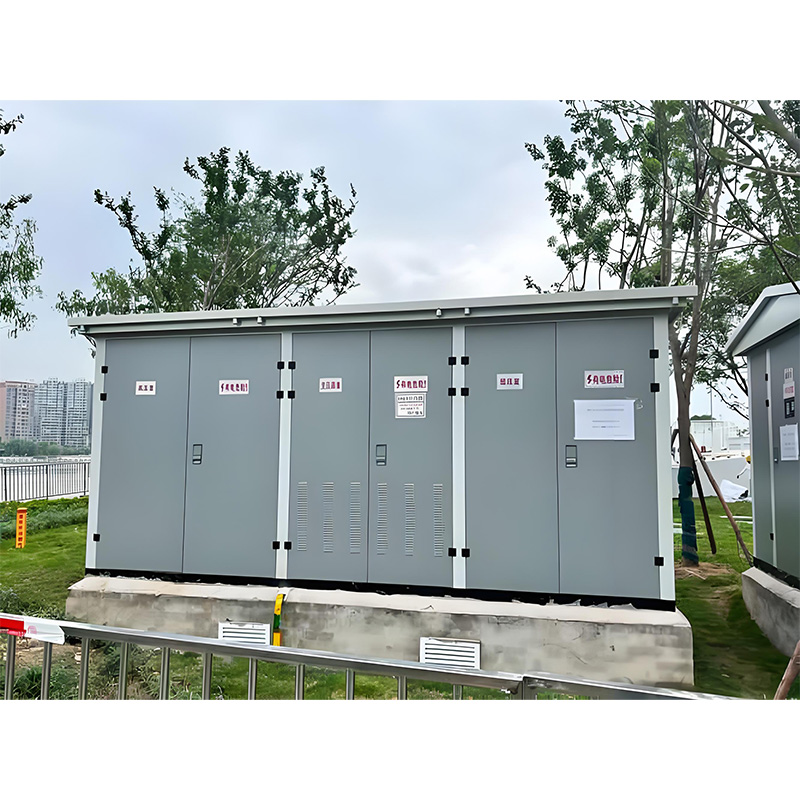
A modular substation building solves this problem. It utilizes tightly engineered, multi-tiered layouts. Planners frequently leverage E-house configurations to maximize spatial efficiency. These enclosures integrate switchgear, transformers, and complex control systems into incredibly compact footprints. Engineers optimize every cubic inch of the interior space. They stack components vertically where safe and utilize advanced insulation technologies to reduce required phase clearances.
These space-saving designs prove ideal for challenging environments. They are perfect for retrofitting existing manufacturing facilities where space remains scarce. Mining sites utilize them to navigate tight topographical constraints. They excel particularly in densely populated urban areas. Acquiring additional real estate is simply cost-prohibitive in modern cities. You can slot compact modular units into narrow alleys, basements, or small utility lots. This footprint reduction minimizes land acquisition costs and simplifies environmental permitting.
Assembling high-voltage components demands strict precision. A clean, ISO-certified factory environment provides exactly this. Technicians work in climate-controlled spaces with optimal lighting and specialized tools at their disposal. Contrast this with an exposed construction site. Field crews battle dust, moisture, extreme temperatures, and uneven terrain. These variables introduce human error and potential equipment contamination.
Comprehensive Factory Acceptance Testing (FAT) represents a major advantage. Manufacturers test the fully integrated system before the unit ever ships. They perform dielectric tests, continuity checks, and relay programming in the factory. This rigorous FAT ensures absolute compliance and operational readiness. You avoid discovering integration failures late in the field commissioning phase.
Facility power demands rarely remain static. Traditional facilities require costly structural expansions to add capacity later. You must hire civil crews again, pour more concrete, and build new structural extensions. This process disrupts existing operations significantly.
Modular systems are inherently scalable. Expanding capacity often means seamlessly docking an additional prefabricated module to the existing setup. Manufacturers design these E-houses with future integration in mind. You simply remove a temporary end-wall panel and bolt on the new section. This modularity allows developers to phase their CAPEX investments. You can build for today's load and easily expand when future demands materialize.
Selecting the right infrastructure model requires objective analysis. We developed a shortlisting logic matrix to provide decision-stage clarity.
Table: Shortlisting Logic Matrix
Evaluation Criteria | Traditional Stick-Built Construction | Prefabricated Modular Substation |
|---|---|---|
Project Timeline | Flexible schedules; delays are acceptable | Strict deadlines; speed-to-market is critical |
Site Geography | Open, expansive land; easy site access | Space-constrained urban or remote sites |
Labor Availability | Abundant local specialized trades; low rates | Severe labor shortages; high mobilization costs |
Cost Predictability | Tolerant of variable costs and change orders | Requires fixed-price certainty upfront |
System Complexity | Ultra-high voltage (UHV); massive clearances | Medium to high voltage; standard distribution |
When to Choose Traditional Construction:
You operate ultra-high voltage transmission yards demanding massive, open-air clearance requirements.
You need highly customized, non-standard layouts where modular form factors present impossible transport limitations.
You manage projects where land and local labor are exceptionally cheap, and completion timelines remain highly flexible.
When to Choose a Prefabricated Substation:
You face strict deadlines where speed-to-market serves as the primary ROI driver.
You build in remote locations, extreme climates, or regions experiencing exorbitant local labor rates.
You navigate space-constrained sites requiring compact, efficiently engineered E-house solutions.
Transitioning to modular infrastructure fundamentally shifts project risk. You move the financial and scheduling risks from the unpredictable construction site directly to the controlled manufacturing floor. This shift delivers timeline certainty, superior quality control, and optimized spatial footprints. Traditional methods still hold value for massive open-air transmission yards, but modern developers increasingly favor the parallel execution speeds of modular designs.
We recommend conducting a site-specific feasibility study as your immediate next step. You should also execute a rigorous logistical transport assessment to verify shipping routes before finalizing any procurement strategy. Analyze your bridge weight limits and highway clearances early.
Take action today to optimize your next deployment. Encourage your project stakeholders to contact our engineering team. We will gladly provide a comparative CAPEX/OPEX assessment based directly on your specific single-line diagram (SLD). Let us help you accelerate your energization schedule.
A: Yes, they generally suit distribution and medium-to-high voltage transmission applications. However, ultra-high voltage projects often require traditional open-air yard designs. Strict phase clearance rules at extreme voltages make housing the equipment inside transportable modules impractical. For most commercial and industrial loads, modular units handle the voltage requirements perfectly.
A: Shipping constraints heavily dictate design. Manufacturers engineer skid-mounted modules to navigate highway clearances, bridge weight limits, and turning radiuses legally. If a facility requires massive capacity, engineers split the system into multiple transportable sections. Field crews then dock these sections together on-site, balancing logistical reality with operational scale.
A: A prefabricated substation offers an equivalent lifespan of 30 to 40-plus years. Properly engineered enclosures feature robust NEMA/IP ratings and dedicated HVAC controls. These climate-controlled environments actually protect internal switchgear from harsh environmental degradation, dust, and moisture much better than many traditional, exposed setups.


